
 IGCAN Directory
 login/create account
 Donate
2024 Winner Spotlight
A Versatile Endometrial Cancer Education Video - Tool for Underserved Communities: A Pilot Project
Project Lead: Dr. Eleanor Richards
Organization: University of Manchester
Target Population: Endometrial cancer awareness for Black and South Asian Communities in the UK
“The IGCS EDI Fund enabled us to work alongside minoritised communities to co-create culturally meaningful resources that challenged misconceptions, amplified lived experiences, and measurably improved awareness and confidence around womb cancer.”
What does success look like for you in the context of this project? How do you think the impact of your project will evolve over time?
This project aimed to address the low awareness of, and common misconceptions about, womb cancer (also called uterine or endometrial cancer) by co-creating an awareness campaign with minoritised communities around Greater Manchester, UK. We also hoped that the resources created could be adapted for other environments and populations.
Our success was therefore defined by:
- engagement with and learning from communities;
- creation of the educational materials;
- the impact of the awareness campaign on the public’s understanding of womb cancer;
- and whether the materials would be utilised outside of Manchester.
We have been blown away by the communities’ interest in this project and engagement with the co-creation process. During campaign development we ran focus groups, co-facilitated by researchers of African and Pakistani heritage, with women of Pakistani (n=7), Indian (n=3), Bangladeshi (n=3), African (n=6), and Caribbean (n=1) heritage. Participants' ideas and reflections were used to develop campaign priorities and creative concepts. Draft plans for the campaign were presented back to the groups for participant-led, iterative development.
Women advised that personal stories of post-menopausal bleeding and womb cancer diagnosis from representative individuals speaking their own languages must be central to the campaign. Involving husbands and children would highlight roles that family members can play in supporting people at risk of womb cancer. Positive messages could address fear, cancer fatalism and concerns about hysterectomy. Our focus group participants also confirmed that often people in their communities think that cervical screening tests for all gynaecological cancers, and so we would need to address this belief too.
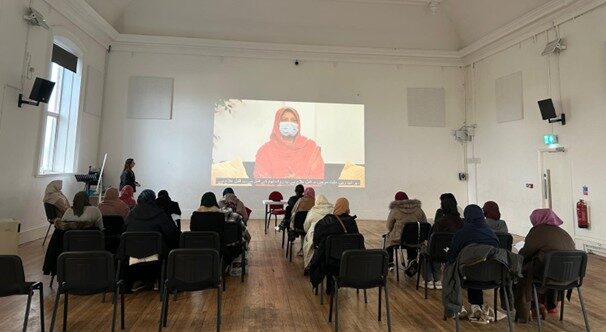
Campaign videos therefore utilised semi-structured interviews with Black and South Asian womb cancer survivors and individuals at risk of womb cancer to highlight personal experiences in their own words. An animated video, including characters representative of the diverse Black and South Asian audiences, was also developed to describe the clinical pathway after recognition of symptoms. The animated video also aimed to address misconceptions about womb cancer, including clarifying the definition of menopause, distinguishing womb cancer from cervical cancer, and emphasising the importance of early detection of womb cancer to improve cure rates. The animated video is currently available with both an English and Urdu voiceover, and the video with survivors’ stories is shown in English with Urdu subtitles.
What results were you able to produce with the funding you received?
In order to evaluate the videos that we have created, we ran outreach events in collaboration with local organisations and charities that serve Black and Asian communities in Greater Manchester. So far, we have run three in-person events involving 46 individuals aged between 16 and 77 years and of Black African, Pakistani and Kurdish ethnicity. Individuals attending the events had a broad range of experience of socioeconomic status, with most identifying as heterosexual and not disabled.
Prior to watching the videos, more than half of event participants (53.9%) were “not at all” or “not very” confident that they would be able to recognise a symptom of womb cancer. Having watched the videos, 41.5% felt “very confident” that they could represent a symptom of womb cancer compared with only 7.7% of event participants prior to the video. Recognition of postmenopausal bleeding as a symptom of womb cancer, which is indeed the most common symptom of the disease, increased from 46.0% to 84.6% after watching our campaign video.
We also hoped that our campaign could rewrite some of the historically fatalistic and confusing narrative surrounding womb cancer. Key messages of the videos included the fact that womb cancer is often curable, especially when detected early, and that cervical cancer screening (“smear”) tests do not check for womb cancer. After watching our videos, knowledge that womb cancer is often curable increased from 56.4% of event participants to 83.8%. Knowledge that cervical screening does not check for womb cancer increased from 7.5% to 29.7%, suggesting that more work is still required to address this misconception.
The videos resulted in event participants feeling more confident about talking with their GP about possible symptoms of womb cancer (29/40 strongly agree, 72.5%), and encouraged individuals to talk to their family about the disease (26/42 strongly agree, 61.9%).
The videos themselves were well received, with 80.0% of event participants liking the style of the animation (agree or strongly agree), and 92.7% liking the look or style of the video with survivors’ stories. We did receive feedback that the Urdu translations of the voiceover for the animated video needed to be improved, specifically regarding the words used to distinguish womb cancer from cervical cancer. More event participants felt that their community was represented in the video including survivors’ stories compared to the animated video alone (70.0% strongly agree versus 55.8% strongly agree respectively).
What challenges did you face during the project, and how did you overcome these? Based on this insight or if another location were to replicate this project, what would you do differently?The two main challenges faced during the project were the recruitment of public contributors during the development phase of the campaign and the organisation of the community events to evaluate the videos. Initial strategies for recruitment into the co-creation focus groups involved utilising the networks of local community organisations in Greater Manchester and snowballing. These resulted in good representation of minoritised communities, but meant that the focus groups were relatively homogenous (e.g. our South Asian focus group was solely comprised of Pakistani women). This necessitated an additional, previously unplanned focus group, with intentional recruitment of Indian and Bangladeshi women. Although this required additional time and funding, the involvement of these women in the development of the videos was invaluable and resulted in a product that more closely reflected the diversity of Asian communities.
Working with different community organisations and charities to co-host outreach events and evaluate the videos conferred several challenges. Many local organisations are run by volunteers or people working multiple jobs, meaning they may not be able to respond promptly to queries. There was also a preference for communication by phone or text messages rather than email. This meant that the organisation of events often took some time. In addition, the size, capacity, and mission of each local organisation varied significantly, and this was reflected in differing costs requested by organisation for hosting outreach events. Early involvement of partner community organisations and a clear communication between both parties was essential to the success of the project.
What were some (if any) unexpected learnings or insights you gained from this experience?
I have learnt a lot about how to work well with public contributors and community organisations. A key lesson has been about the need to factor in adequate time to organise events, appreciating the many other demands that community members’ have on their time. I have also learnt to adapt my communication style to those of my community collaborators, and the importance of regular (but not burdensome) check-ins to help keep projects moving forward. Building a trusting relationship with a public contributor or a community organisation takes time, patience, dedication, and clear and consistent communication. Once a trusted relationship has been built, it is also important to maintain it in a way that is appropriate for the situation. For example, public contributors are often keen to hear about updates on the projects that they have been involved in. It is incredibly rewarding for all involved if the impact of a contributors’ time and voice can be demonstrated to them, and it also allows us to express our sincere thanks to contributors for their time and effort. We will be sending out updates and thanks via community organisations’ WhatsApp channels, and later organising a party to thank all involved and launch the campaign officially.
How did your project contribute to the goals of equity, diversity, and inclusion, and how has your perspective evolved as a result of this work?
By raising awareness of womb cancer and its symptoms, and addressing common misconceptions and fears, we hope that this campaign will enable people from minoritised communities to overcome common barriers to accessing care for possible womb cancer symptoms. Our methods have centred the voices of Black and Asian women throughout, and we have already seen that this representation on and off screen has resonated strongly with our target audiences. This work is particularly important for equity given that in England, Black women are more likely to develop womb cancer, to have advanced disease at presentation, and to die from their disease than women from any other racial and ethnic group.
Personally, I have learnt so much from our public contributors and collaborating community organisations about how they understand and relate to information about gynaecological cancers. Having the time to build a trusting relationship with these individuals and explore their experiences and concerns has been a true privilege, and I will take this learning with me throughout the rest of my career as a gynaecology doctor and researcher.
About the Dicey Scroggins Fund for Equity, Diversity, and Inclusion in Gynecologic Cancer Patient Outreach
This fund was established to support projects and initiatives that address disparities in gynecologic cancer patient care. By providing financial support to innovative and inclusive projects, the fund aims to contribute to a more equitable and diverse landscape in the field of gynecologic cancer research and outreach. Named in honor of Dicey Scroggins, the founder of IGCS’ global patient advocacy network, International Gynecologic Cancer Advocacy Network (IGCAN).
About the International Gynecologic Cancer Advocacy Network
The purpose of the IGCAN is to create and sustain a broad Network of organizations and individuals that work collaboratively—in sisterhood—“to enhance the care of women with gynecologic cancers worldwide,” with the core value that every woman under every circumstance deserves and must receive the best possible quality of care and quality of life, resulting in best outcomes.